
George Cross
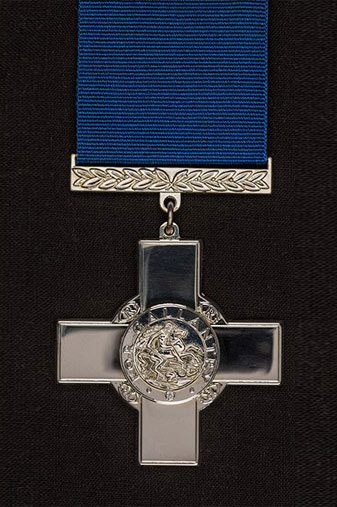
The George Cross (GC) is the highest civil decoration of the United Kingdom, and also holds, or has held, that status in many of the other countries of the Commonwealth of Nations.
The GC is the civilian counterpart of the Victoria Cross (VC) and the highest gallantry award for civilians as well as for military personnel in actions which are not in the face of the enemy or for which purely military honours would not normally be granted.
The GC was instituted on 24 September 1940 by King George VI. At this time, during the height of The Blitz, there was a strong desire to reward the many acts of civilian courage. The existing awards open to civilians were not judged suitable to meet the new situation, therefore it was decided that the George Cross and the George Medal would be instituted to recognise both civilian gallantry in the face of enemy action and brave deeds more generally.
More information
Announcing the new award, the King said: “In order that they should be worthily and promptly recognised, I have decided to create, at once, a new mark of honour for men and women in all walks of civilian life. I propose to give my name to this new distinction, which will consist of the George Cross, which will rank next to the Victoria Cross, and the George Medal for wider distribution.
The Warrant for the GC (along with that of the GM), dated 24 January 1941, was published in the London Gazette on 31 January 1941.
The GC was intended to replace the Empire Gallantry Medal (EGM); all holders of the EGM were instructed to exchange their medals for a GC, a substitution of awards unprecedented in the history of British decorations. This substitution policy ignored holders of the Albert Medal (AM) and the Edward Medal (EM), awards which both took precedence over the EGM.The anomaly was only rectified in 1971, when the surviving recipients of the AM and the EM were invited to exchange their award for the George Cross. Of the 64 holders of the Albert Medal and 68 holders of the Edward Medal eligible to exchange, 49 and 59 respectively took up the option.
The George Cross, which may be awarded posthumously, is granted in recognition of “acts of the greatest heroism or of the most conspicuous courage in circumstances of extreme danger.”
The cross is primarily a civilian award; however the George Cross may be awarded to military personnel for gallant conduct which is not in the face of the enemy. As the Warrant states:
The Cross is intended primarily for civilians and award in Our military services is to be confined to actions for which purely military Honours are not normally granted.
Honoured
Wallace Launcelot Andrews
115829 Second Lieutenant
Wallace Launcelot Andrews
George Cross
22/23 Bomb Disposal Section
Royal Engineers
13 March 1908 to 30 July 1944.
No file could be found at National Archives, source of information tracesofwar.com.
London Gazette entry not found.
Near Croydon, Surrey on 26th August 1940, Second Lieutenant Andrews was in charge of Nos. 22 and 23 Bomb Disposal Sections when a bomb which fell near the aerodrome failed to explode. It was necessary to extract the fuze if possible in order to forward it to the Department of Scientific Research, but several attempts were made to remove it without success. Lieutenant Andrews then told his men to take cover and after tying a piece of cord to the ring of the fuze discharger, pulled, with the result that the bomb exploded: he was blown a considerable distance and two of his men received splinter wounds.
For this action, Second Lieutenant W.A. Andrews was awarded the Empire Gallantry Medal, (EGM) which later was exchanged for the George Cross. He also received the Defence Medal 1939–1945.
On the 30th of July 1944, the now Major Andrews died of war wounds sustained whilst Chief Instructor Bomb Disposal Ripon.
In 1976 the family offered to sell the medal to the Royal Engineers Museum. This offer was not taken up and it is assumed that the medal was then sold privately.
Bertram Stuart Trevelyan Archer
126305 Second Lieutenant, Acting Lieutenant
Bertram Stuart Trevelyan Archer
George Cross, OBE, ERD
104 Bomb Disposal Section
Royal Engineers
The Recommendation is from file WO373/66/1346 held at the National Archives.
Placed in London Gazette on the 30th of September 1941. Supplement 35292. Page 5653.
Lieutenant Archer has been employed on bomb disposal work since June 1940 and has dealt with some two hundred bombs, in addition to a number of incidents mentioned below. He provided the War Office with the numbers 17, 25, 26, 38 and 50 fuzes and Zus anti-handling device for experiments, at a time when little was known about the nature of German fuzes.
On 15 July 1940 four 250 kilogram bombs were dropped on St. Athan aerodrome, South Wales, two of them within ten yards os some vitally important assembly shed. Lieutenant Archer immediately went to the scene and the first bomb was excavated. As its fuze, was expected to be a booby trap, it was loaded, with the fuze still in, on to a lorry; Lieutenant Archer himself drove the lorry to a site some two miles away and the bomb was detonated. The other bomb was dealt with in the same way.
On the 17 August 1940, at Moulton, South Wales, a 250-kilogram bomb was excavated down to the fuze pocket, which contained a number 50 fuze. As this fuze required for War Office experiments, an attempt was made to extract it by means of a cord, and, when this failed, Lieutenant Archer removed it by hand by means of a pick head; although well aware that the fuze might be a booby trap.
On the 27 August 1940, at Port Talbot Docks, this officer was instrumental in recover the first No. 38 fuze for experimental purposes.
On the 2 September 1940, a vast fire was started in six oil tanks after a heavy raid on the National Oil Refineries at Skewen, near Swansea. There were unexploded bombs in and around the oil tank farm and Lieutenant Archer and his party went to work some eight hours after the raid. In spite of the fact that three bombs exploded, he and his men remained working. One 250 kilogram had fallen two feet from the side of an oil tank and when uncovered was found to contain a number 17 fuze, which was ticking. Lieutenant Archer was able to remove the filler cap, scrape away the explosive and remove the whole fuze pocket, which had sheared. As the fuze was required for experiment he removed it by hand from the exploder tube and found inside a Zus anti-handling device which had not functioned, and this too he removed by hand. This was apparently the first Zus to be successfully extricated.
In addition to the above incidents. Lieutenant Archer has on three occasions driven lorries containing bombs with number 17 fuzes in order to remove them from sites.
The Inspector of Fortifications and Director of Bomb Disposal, states that the fact that Lieutenant Archer has enjoyed much remarkable immunity from death in no wat detracts from his record of deliberate and sustained courage, coupled with devotion to duty of the highest order.
His Citation reads: “The King has been graciously pleased to approve the award of the George Cross in recognition of the most conspicuous gallantry in carrying out hazardous work in a very brave manner. Having reached the rank of Colonel, Archer retired in and is has been Chairman of the VC and GC Association since August 1940.
Herbert John Leslie Barefoot
Lieutenant Acting Captain
Herbert John Leslie Barefoot
George Cross
Bomb Disposal
Royal Engineers
15th May 1887 to 23rd December 1958
The Recommendation is from file WO373/66/341 held at the National Archives.
Placed in the London Gazette on the 22nd of January 1941. Supplement 35050. Page 461.
Captain Barefoot was a pioneer of bomb disposal. He dealt with the first unexploded bombs which fell in this country, and by his disregard of personal safety very valuable information was obtained. He has experimented with all types of bombs. With a Naval, officer he worked on the first suspended parachute magnetic mine. For two hours he clung to the mine to secure it in a safe position. At the time of this act, the bomb disposal authorities had very little knowledge of the mechanism of these mines and much was learned at this stage. When necessary he has ignored the safety period, especially when clearing an important railway line. His bravery and devotion to duty has done much to maintain a high standard of courage in his Company. For these actions, Acting Captain H.J.L. Barefoot was recommended for the George Cross.
His citation reads: “The King has been graciously pleased to approve the award of the George Cross, for the most conspicuous gallantry in carrying out hazardous work in a very brave manner.
He was also awarded the British War Medal, Victory Medal with Oak Leaf, Defence Medal, War Medal for his service, and later the 1953 Coronation Medal.
Interestingly Barefoot also served in WW 1 in both the RNVR and the Sanitary Company of the RAMC.
Michael Flood Blaney
19978 Second Lieutenant Acting Captain
Michael Flood Blaney
George Cross (Posthumously)
Bomb Disposal
Royal Engineers
19th November 1910 to 13th December 1940.
The Recommendation is from file WO373/66/859 held at the National Archives.
Placed in the London Gazette 15th April 1941. Supplement 35136. Page2177.
The work performed by Captain Blaney and the many acts of heroism to his credit is a continual story of gallantry and outstanding bravery and devotion to duty. He was the finest type of Bomb Disposal Officer, combining the highest personal courage with the greatest possible regard for the safety of others.
He was responsible for the adaption of the policy of removing bombs wherever practicable in preference to blowing them up where they sat, by this means saving hundreds of people anxiety and loss of valuable property. he always personally insisted on removing a fuze unaccompanied.
0n 5th December 1940, an unexploded bomb fell in the premises immediately abutting the main London-Chelmsford Road (Romford Road Manor Park). On the 13th December 1940, in view of the serious dislocation of important traffic, Captain Blaney proceeded to attempt to remove the fuze (one time fuze). The alternative method of sterilizing the bomb was not at the time available and at great personal risk, and with full knowledge of the grave danger, he personally entered the crater to carry out the process. Unfortunately, the bomb exploded and Captain Blaney lost his life.
His citation reads “The King has been graciously pleased to approve the award of the George Cross, for most conspicuous gallantry in carrying out hazardous work in a very brave manner.
Other incidents.
In the early hours of the 18th September 1940, an unexploded bomb landed in the middle of Manor Way. This was a short distance from the junction with East Ham and Barking bypass. This caused traffic, to the Royal Arsenal and other strategic industrial undertakings, to grind to a standstill. Acting Captain Blaney was called and removed the bomb, enabling thousands of war-workers to continue on their way to work.
The 20th October saw an unexploded bomb fall in Park Avenue, East Ham. The bomb was fitted with two dangerous time fuzes, very few bombs were fuzed in this manner, and therefore it was a very real threat to Public Utility Services, and of a great threat to the Bomb Disposal Section when they were defusing it. Captain Blaney personally defused the bomb, as normal, it was his practice to work alone.
After the War, a road nearby to where he lost his life was named after him.
William John Button
737038 Lance Sergeant
William John Button
George Cross
48 Bomb Disposal Section
Royal Engineers
1904 to 10th March 1969.
No file found on the National Archives source of information www.sourcesof war
Placed in the London Gazette 17th September 1940. Supplement 35060. Page 623.
On the morning of the 18th August 1940, Lance Sergeant Button was ordered with his Section to continue the work of excavating an unexploded bomb. Although he knew full well that, owing to the time already spent on the excavation the bomb was liable to explode at any moment, he continued the work of his section with great coolness. The bomb was eventually exploded, with No 48 BD Section was ordered to continue the excavating of an unexploded bomb. Due to the time already elapsed on the excavation, Button knew that there was a strong possibility that the bomb could explode at any time. Regardless of this, he continued with his section to excavate the bomb, showing great coolness. Eventually, the bomb exploded, killing five Sappers of his section, and throwing Lance-Sergeant Button a considerable distance. Although considerably he behaved with great coolness, collected the rest of his Section at a safe distance, ascertained that none of them was injured, notified the First Aid Detachment, and reported to his Section Officer by telephone.
For his actions Lance Sergeant W.J. Button was awarded the Empire Gallantry Medal, later this was exchanged for the George Cross.
Alexander Fraser Campbell
135004 Second Lieutenant
Alexander Fraser Campbell
George Cross
9 Bomb Disposal Company
Royal Engineers
2nd May 1898 to 18th October 1940
The Recommendation is from file WO373/66/682 held at the National Archives.
Placed in the London Gazette on the 22nd of January 1941. Supplement 35050. Page 461.
17 October 1940. COVENTRY.
Campbell was engaged with his Section on the removal of a 250 Kilo unexploded bomb at the Triumph Engineering Co’s Works, Coventry, situated in the center of the City. This bomb had caused cessation of war production in two factories involving some 1,000 workers and the evacuation of a number of residents. For this reason, 2/Lieut Campbell worked practically without rest for nearly 48 hours until the bomb was removed. On Thursday 17 October, the bomb was finally exposed and examined by 2/Lieut Campbell; it was fitted with a delayed-action fuze which it was impossible to remove. He decided to remove it to a safe place for destruction.
Recognising the extreme danger involved he removed the bomb by lorry for a distance of approximately a mile, himself laying alongside the bomb listening for action by the clock mechanism. The bomb was safely disposed of.
He was thoroughly experienced in the work of bomb disposal and knew exactly the risks he was taking. In view of all the circumstances, his instant decision to act as described and complete lack of consideration for his personal safety constitutes an act of gallantry of the highest degree and I strongly recommend an immediate award fitting to the act.
Keresley Manor,
Keresley,
Coventry,
23/10/40
Recommended by the Warwickshire and Coventry Sub-Area Commander 26 October 1940.
Endorsed by Commander Midland Area and General Officer Commanding Western Command.
It was with the deepest regret that this Officer was killed the following day (18 October) whilst dealing with another bomb.
Campbell’s citation reads; The King has been graciously pleased to approve the award of the George Cross, for most conspicuous gallantry in carrying out hazardous work in a very brave manner. His other service awards were 1914/15 Star, British War Medal, Victory Medal, Defense Medal and War Medal 1939/45
Further Information.
Regrettably, 2nd/Lt Campbell, Sergeant M.Gibson, Sappers W. Gibson, R.Gilchrest, J. Plumb, and R. W. Skelton were all killed the next day 18 October 1940. See their entries on the Roll of Honour for more detail.
In 2006 a memorial plaque at Whitely Common, Coventry was dedicated to the Remembrance of these brave men by the local Historical Society.
Robert Davies
Acting Lieutenant
Robert Davies
George Cross
Bomb Disposal
Royal Engineers
3rd October 1900 to 27th September 1957
Placed in the London Gazette on the 30th of September 1940. An unexploded bomb fell in close proximity to St Paul’s Cathedral, 12th September 1940, Lieutenant Davies was the Officer in Charge of the party called upon to recover the bomb. Lt Davies was conscious of the imminent danger this bomb presented to St Paul’s and regardless of the risk to himself or his men, he spared nobody in the search for this bomb. The bomb was located by Sapper G.W. Wylie, who located it deep under the pavement in front of St Paul’s. By unremitting efforts the bomb was removed, all the time Davies and his party were aware of the strong possibility that the bomb would explode. To prevent his men from further risk Davies drove the vehicle himself to transport the bomb and carried out its disposal. For this action, Lieutenant R. Davies and Sapper G.W. Wylie were awarded the George Cross. Lt Davies citation reads; The King has been graciously pleased to approve the award of the George Cross as Officer in charge of the party dealing with the St Pauls bomb.
Michael Gibson
4445289 Sergeant
Michael Gibson
9 Bomb Disposal Company
George Cross
Royal Engineers
The Recommendation is from file WO373/66/689 held at the Nation Archives.
Placed in the London Gazette on 21 January 1941. Supplement 35050. Page 461.
On 14th September 1940, a large unexploded bomb fell in an important factory. Excavation supervised by Sergeant Gibson began, during which time another bomb which had dropped nearby exploded. Despite the knowledge that the bomb on which he was engaged was of a similar type the N.C.O. persevered and eventually, the bomb was uncovered. On uncovering it an unusual hissing noise was heard coming from the bomb, whereupon Sergeant Gibson sent his men away and immediately set to work on the fuze. This he extracted safely and the bomb was eventually removed. His prompt and courageous action saved a very dangerous situation.
Initially recommended for the Military Medal (Immediate Award) by Colonel L .G. Trench. D.S.O C.M.G Commanding Birmingham and South Staffs Sub-Area on the 07 January 1940.
Awarded the George Medal
Cyril Arthur Joseph Martin
144910 Temporary Major
Cyril Arthur Joseph Martin
George Cross, Military Cross
Bomb Disposal
Royal Engineers
23rd July 1897 to 27th November 1973
The Recommendation is from file WO373/67/523 held at the Nation Archives.
Placed in the London Gazette on the 9th March 1943. Supplement 35934. Page 1175.
During the air attack on London on the night 17/18th January 1943., a large caliber bomb fell in the warehouse of the Victorian Haulage Company at Battersea and after tearing its way through the roof girders, machines and packing cases, came to rest unexploded immediately beneath the bedplate of a very large lathe. From the beginning of the Blitz and during the heavy raids of 1940/41, Major Martin carried out Bomb Disposal work and dealt with a large number of unexploded bombs during this period.
Owing to the fact that the warehouse was full of new and heavy machine tools from the U.S.A the Ministry of Supply applied to the Regional Commissioner for Category A1. This was granted and on the morning of the 18th January 1943, a working party began disposal operations. During the day of 18th January, another Category A1 bomb had been found to contain an entirely new type of fuze which, on examination, during the night 18/19th January, was found to embody characteristics which indicated it not only to be more formidable as an anti-handling and a booby trap than any other type so far met but to be proof against any known technique or equipment. On the same night, the bomb at Battersea was identified as a 500 kilogram with two fuzes and the casing so distorted as to render their withdrawal impossible and on further investigation one of the fuzes was found to be of the new type. This necessitated shutting down the machinery of a large flour mill next door to the Victorian Haulage Company, owing to excessive vibration, and work on the bomb was temporarily suspended.
In view of the urgent necessity for getting the flour mill to work again and for removing the threat to the machinery of the utmost importance to the war effort, it was decided to attempt the remove the base plate of the bomb and extract the main explosive filling. Major Martin, who was fully aware of the extremely formidable characteristics of the new fuze, undertook the task and assisted by Lieutenant Deans on the 20th January, succeeded in removing the base plate only to find the bomb contained solid case T.N.T., which could only be removed by the application of high-pressure steam. It was considered that the risk of detonating the bomb would be too great if the normal steaming out process was used by remote control owing to the very high temperature generated and the excessive force of the steam jet, the effect of which on a possibly loosened fuze pocket could not be foreseen. It was decided, therefore, that the only way was to apply the steam nozzle by hand and only long enough at a time to soften the T.N.T sufficiently to allow it to be scraped away in small quantities. This not only entailed further excavation to make the working space and supporting the bomb in such a way that it could not slip or be inadvertently moved but also involved two men to be constantly in the bomb pit to manipulate the steam and cooling water pipes and to scrape away softened explosives. This extremely hazardous work was undertaken by Major Martin who, assisted by Lieutenant Dean and, worked continuously from the afternoon of Wednesday 20 January, through the night until 0830am on the 21st January, by which time that had succeeded in removing the entire main filling of cast T.N.T. from the bomb. The work was carried out in a cramped hole filled with steam and water in which they had to lie alongside the bomb for nearly 24 hours, during which time both officers had every reason to believe they were in extreme danger. Throughout the long and hazardous operation, Major Martin displayed cold-blooded courage and tenacity of purpose with complete disregard for the appalling risks involved.
Another 500-kilogram bomb fell on the night of 17/18th January 1943 and came to rest 8 to 10 feet under the road surface in a side street adjacent to the Old Kent Road. This was subsequently found to contain one of the new types of fuzes. On Tuesday 2 February 1943, Major Martin using a newly developed technique and apparatus attempted to withdraw the fuze. The fuze was stuck fast and on force being applied the head of the fuze broke off leaving the body inside the fuze pocket. In order to avoid attempting to remove through the streets in a potentially dangerous condition and to try out for experimental purposes a method of rendering the damaged fuze safe, Major Martin undertook the task of operating on the fuze with improvised apparatus and tools and was fully aware of the danger involved. The successful completion of the operation called for the utmost care, cool courage, and dogged perseverance under conditions of great physical and mental strain over a long period.
On Thursday 4 February 1943, Major Martin was superintending the use of newly developed apparatus on another 500-kilogram unexploded bomb containing one of the new type of fuses. The bomb was lying at the bottom of a deep and badly ventilated shaft underneath a house. The process had reached a critical stage, and an officer under instruction by Major Martin was at the bottom of the shaft making final preparations when he found his clothing to be on fire and flames coming from the apparatus on the bomb. The officer managed to climb up the ladder which was now also on fire and give warning. Major Martin, assisted by another officer put out the flames coming from the apparatus on the bomb and despatched the officer to hospital. The cause of the fire was unknown but was thought to be connected to certain chemicals used in the new process. Notwithstanding this Major Martin went to the bottom of the shaft and continued work until the fuze had been successfully dealt with. As he did not know the actual cause of the fire and realised the probability of a recurrence with grave risk of subsequent detonation, to continue this operation called for courage and endurance of a very high order.
Since the night of 17/18th January 1943, Major Martin has rendered invaluable assistance by carrying out trials of newly developed apparatus on eight bombs found to contain fuzes of the new type so far with complete success, but in all cases the element of grave personal risk has been high, calling for sustained courage and tenacity of purpose over long periods of time.
Major Martin has been intimately concerned on Bomb Disposal operations in the London Area since September 1940. During the heavy raids of 1940/41, he personally dealt with a large number of unexploded bombs many of which were of the delayed action type. his contributions to the technical development of Bomb Disposal techniques has been valuable and at all times he has displayed the same cool deliberate courage with complete disregard for personal danger. Recommended for the George Cross.
Major C.A.J. Martin’s George Cross was awarded for multiple acts.
Major Martin’s citation reads; The KING has been graciously pleased to approve the award of the George Cross, in recognition of most conspicuous gallantry in carrying out hazardous work in a very brave manner. Martin had received a Military Cross during World War 1, as a 2nd Lieutenant in the RGA Special Reserve. The London Gazette reads for this award; For conspicuous gallantry and devotion to duty, he with two men extinguished a burning ammunition dump, under heavy and continuous fire, while overheated ammunition exploded nearby, he showed great coolness and resource.
Further information.
Lieutenant R.W. Deans assisted in this operation, he was awarded a George Medal see separate entry.,
Arthur Douglas Merriman
Doctor Arthur Douglas Merriman
Part Time Experimental Officer
Directorate of Scientific Supply Research
Ministry of Supply
Bomb Disposal
Royal Engineers from 1942.
George Cross, Order of the British Empire
25th November 1892 to 4th November 1972.
Placed in the London Gazette on the 3rd December 1940. A brief explanation is necessary to explain Dr A.D. Merrimans inclusion under Royal Engineer Bomb Disposal, George Cross awards. Dr Merriman received an emergency general list commission in December 1940. He was sent to the C in C Middle East as Assistant Director Bomb Disposal. In 1942 he was transferred to the Royal Engineers. Late 1942 he was a Major, (Temporary Lt Colonel) Dr Merriman was awarded the George Cross for; As an Experimental Officer, for the Directorate of Scientific Research, who tackled some of the first bombs to fall on Britain early in the summer of 1941. Supposedly Merriman was only part time in his position, with predominantly Office duties, he in fact on many occasions dealt with dangerous bombs at the request of the War Office and Air Ministry, in these roles he was a volunteer. As Director General of Scientific Research, he on the 11th September 1940 dealt with a bomb, which had fallen in Regent Street, London.The bomb was heard to be ticking as they started work, they all were aware that this meant the bomb was on its countdown to explode. The decision was made to remove as much of the explosive filling as possible before that happened. This would reduce the damage and make the bomb relatively harmless. They worked till the last moment, the timing was perfect, at the last moment they got away and the only damage was some broken windows. Doctor A.D. Merriman’s citation reads; The KING has been graciously pleased to approve the award of the George Cross, for conspicuous gallantry in connection with Bomb Disposal.
Edward Womersley Reynolds
Lieutenant
Edward Womersley Reynolds
George Cross
101 and 102 Bomb Disposal Sections
Royal Engineers
27th June 1917 to 16th December 1955
No file located at the National Archives source of information from tracesofwar.com
Placed in the London Gazette on the 17th of September 1940. Supplement 34947. Page 5537
On the 17th August 1940, a 250-kilo bomb fell in a garden amongst some council houses: It did not explode and Lieut Reynolds was sent to investigate. On digging down 17 ft. he found that it had a new type of fuze about which no instructions had at that time been received. Finding that traffic was suspended on the road and that the inhabitants had had to be cleared out of their houses, he removed the fuze and found that it had a clockwork delayed action. The risk that he took was great, and merit of his action was the greater for lack of exact knowledge of the type of fuze he was dealing with.
On 1 September 1940, a large bomb fell in a street just before midnight it wrecked the front of some business premises and was supposed to have exploded. About 16.30 hours on the 3 September, a 250-kilo unexploded bomb was found in the debris. Lieut Reynolds was at once summoned, found that it had a clockwork fuze which was still ticking and according to orders applied to Regional H.Q. for instructions suggesting that the sooner it was dealt with the better, and stating that he was willing to do so forthwith. In view of the damage to property that would have been caused by the explosion of such a large bomb in such a congested area and especially of the possible effect on the public morale, permission was given and Lieutenant Reynold immediately extracted the fuze and rendered the bomb inoperative. The risk in doing this was very considerable.
Initially, the award was the Empire Gallantry Medal exchanged later for the George Cross for the above operations. Lieutenant Reynolds was also awarded the Burma Star, Defence Medal 1939-45, War Medal 1939-45
Ellis Edward Arthur Chetwynd Talbot
100411Second Lieutenant Ellis Edward Arthur Chetwynd Talbot 103 Bomb Disposal Section Royal Engineers George Cross Member of the British Empire.1939-45 Star, Africa Star, War Medal 1939-45 22nd March 1920 to 9th October 1941. Placed in the London Gazette on the 17th September 1940.2nd Lt Talbot on the 24th and 25th of August 1940 was present for the whole period, when a bomb was dug down to, the recovery of this took twelve and a half hours.On reaching the bomb, it was brought to the surface and Talbot investigated and found it was of a delayed action type. He ordered his men to safety.The bomb was found to be of a new type and Talbot decided to move it to a place were it would cause no damage if it exploded. He kept his men at a safe distance and placing the bomb upon his shoulder carried it 200 yards to a safe spot. At all times there was a risk of the bomb exploding. Lt Talbot set a fine example of courage and devotion to duty.2nd Lieutenant Talbot’s citation reads; The King has been graciously pleased to award the Medal of the Military Division of the Most Excellent Order of the British Empire. This was later exchanged for the George Cross.Lt Talbot was killed on the 9th September 1941 near Sicily, whist a passenger on a RAF Blenheim, on a bombing raid.
George Cameron Wylie
1942531 Sapper
George Cameron Wylie
Bomb Disposal
Royal Engineers
George Cross
25th December 1908 to 1st February 1987
On the 12th September 1940 a 2,000kg bomb landed close to St Pauls Cathedral. Sapper Wylie located the bomb in embedded in the soil in Deans yard.Due to its weight and the soft soil, the job of removing the bomb from the ground was an arduous task, which took three days. The task was made that bit more hazardous by a broken gas main, on fire, being nearby.Wylie and his team removed the bomb from the ground and placed it on a lorry that Wylie drove himself, with Lt Davis to Hackney Marshes, where it was detonated by an controlled explosion. The crater was 100ft, what damage would this have caused to St Pauls.Wylies citation reads; The KING has been graciously pleased to award the George Cross, to Sapper Wylie, The actual discovery and removal of the bomb fell to him. Sapper Wylie’s untiring energy, courage, and disregard for danger were an outstanding example to his comrades.

About Us
The aim of the site is to provide a meeting point for all those involved in Explosive Ordnance Disposal (EOD) or Search whether serving or ex-serving members of the Royal Engineers and a source of material for those researching the work of the Royal Engineers or family history
Links
Donate
If you wish to donate to the running of the branch, please use the button below.
Terms & Conditions | Privacy Policy | Copyright © 2023 The Royal Engineers Association.
All rights reserved.